

Major Research Project (DM3107)
Word Count: 2122
Introduction
The Main objective of this project is to investigate ‘how advanced 3d game development pipelines support the digital reconstruction of the lost lighthouse of Alexandria in an educational context’. Within this page, I will 3d model the lighthouse to help answer the research question. I will present the model in an educational interpretation to offer a visual 3d perspective to improve cultural understanding and historical learning, which will support my commitment to sdg 4. I will be creating a storyboard that goes through the history of the structure using my completed model, which will include images and captions.
Lighthouse Of Alexandria Storyboard
The storyboard I have created is an interactive learning experience; each image is supported by captions that explain the historical significance and its architectural features. This storyboard aims to enhance SDG 4 by supporting learning and the educational focus of the project. Full references and sources will be placed at the end of the project.
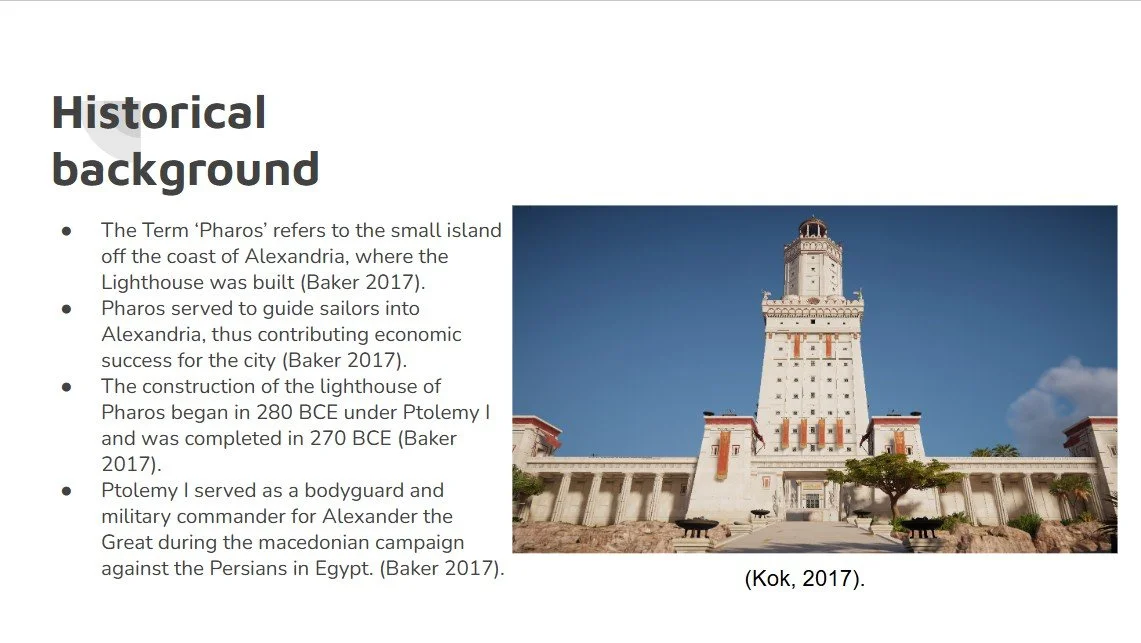
Figure 1
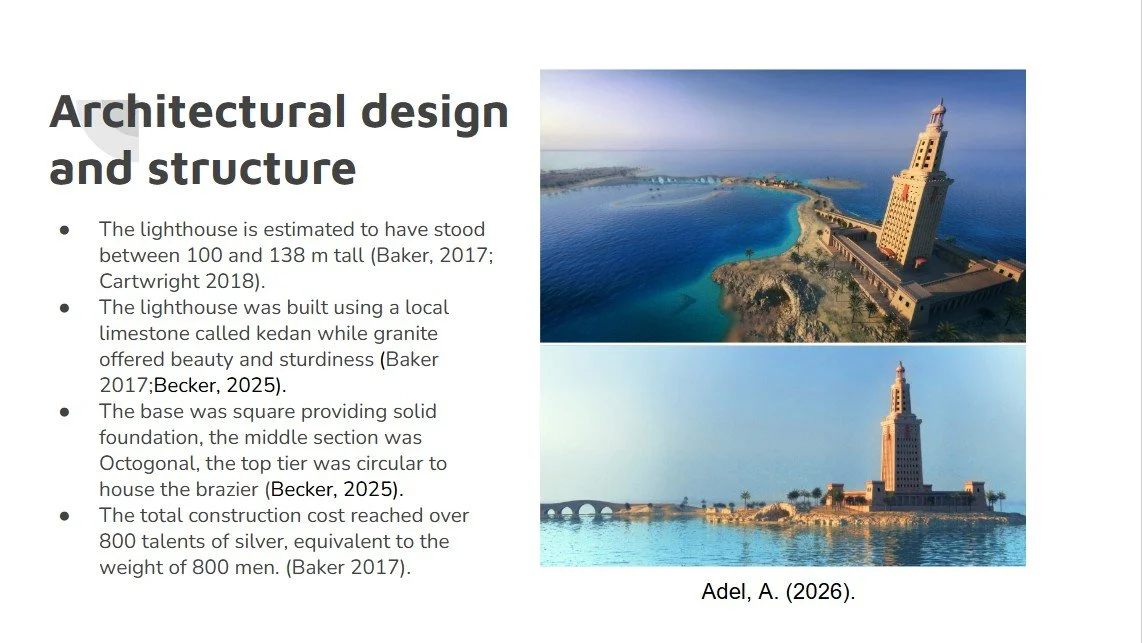
Figure 1.1
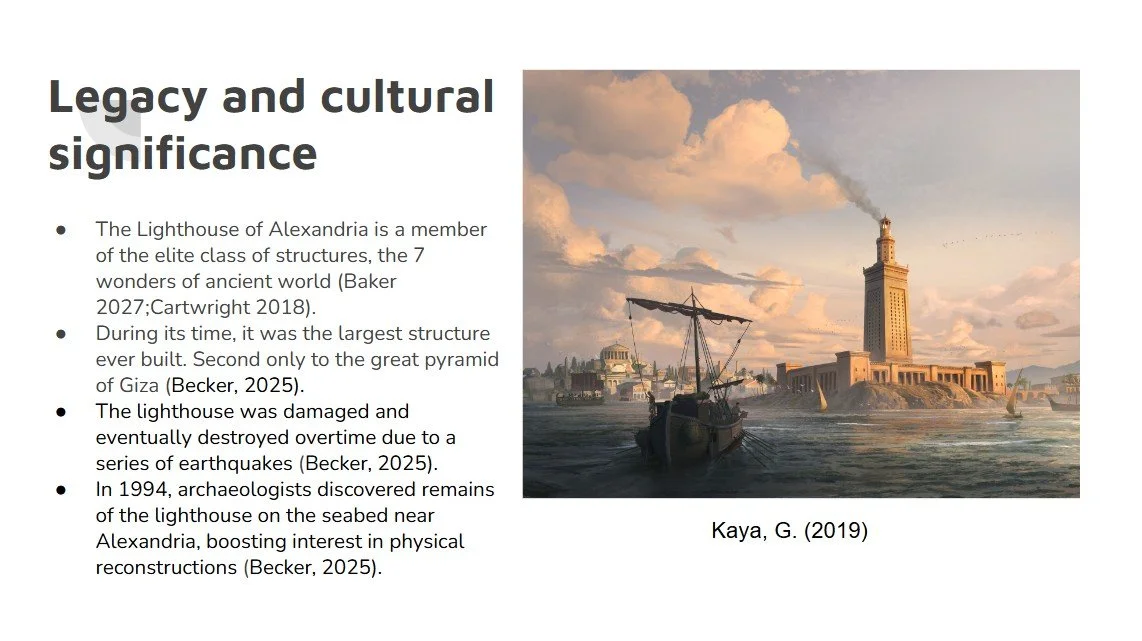
Figure 1.2
Lighthouse Concept sketch
The lighthouse sketch shows my clear and direct goal for the 3d model that I am planning to develop. Within the written research work, I planned to use a modular asset workflow and pipeline, which will also contain a modular asset pack. The annotations on the sketch represent the assets that will be within the handover modular pack.
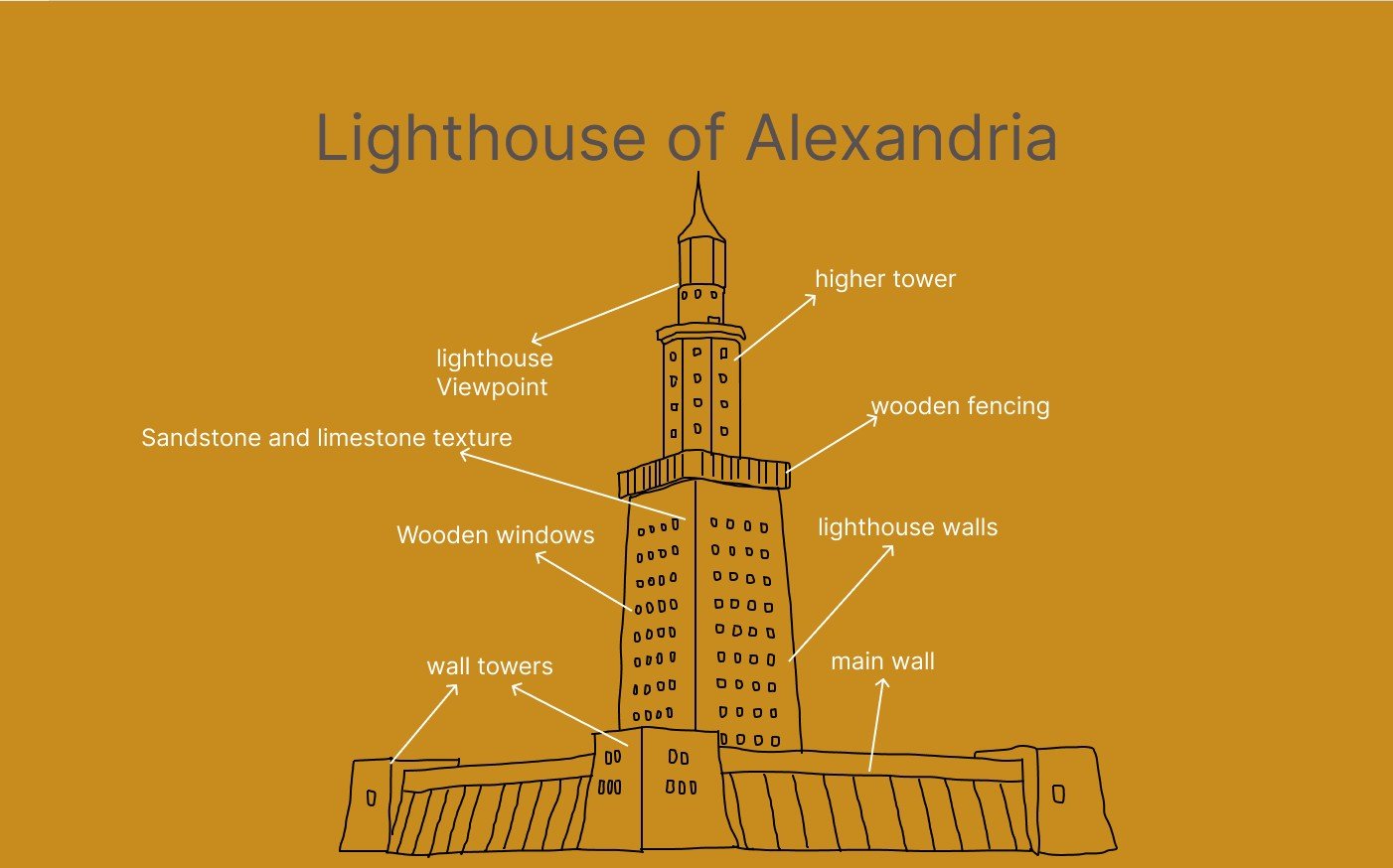
Figure 1.3
Modelling development 01
(Lighthouse base)
Main Body
Two modelling approaches were discussed. One way was to create a basic cube shape, which, while it may have been easier to have helped manage geometry, would not have fit the historically accurate art direction that I was going for. The key skills used for this task was the extrude tool, which created the inward face. The scale tool was used to create the angled structure.
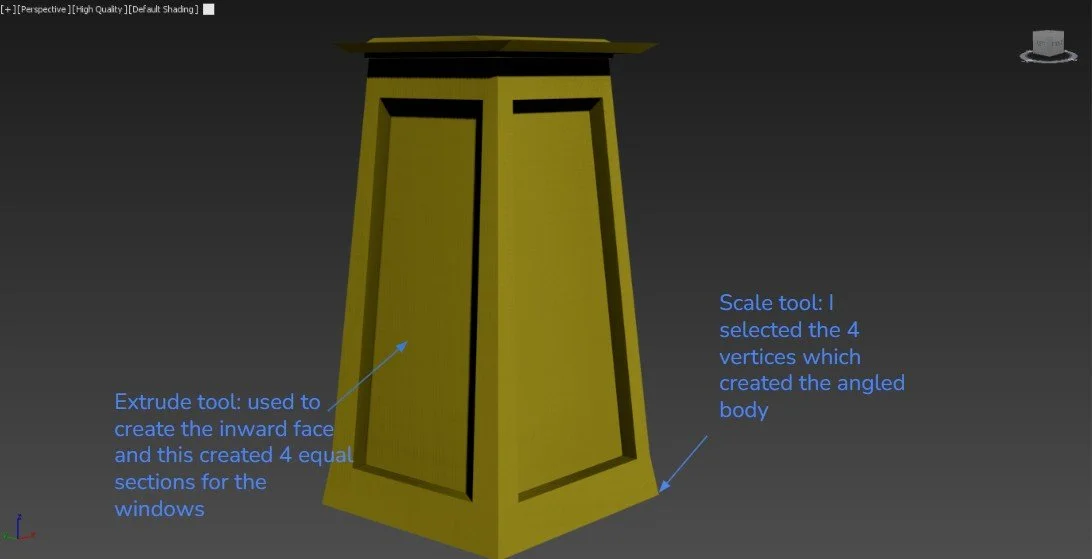
Figure 1.4
Main doors
This task required a balance between creative interpretation and historical realism. The main doors were difficult to model accurately due to a lack of visual sources. The addition of wooden planks and golden beads (Figure 1.5) represents the blend of efficient construction and extravagant wealth. This reflects the cultural significance and immense cost of 800 talents (Baker 2017). This demonstrates how I included elements of creativity and historical accuracy supported by feedback from poll 1 (Appendix 1)
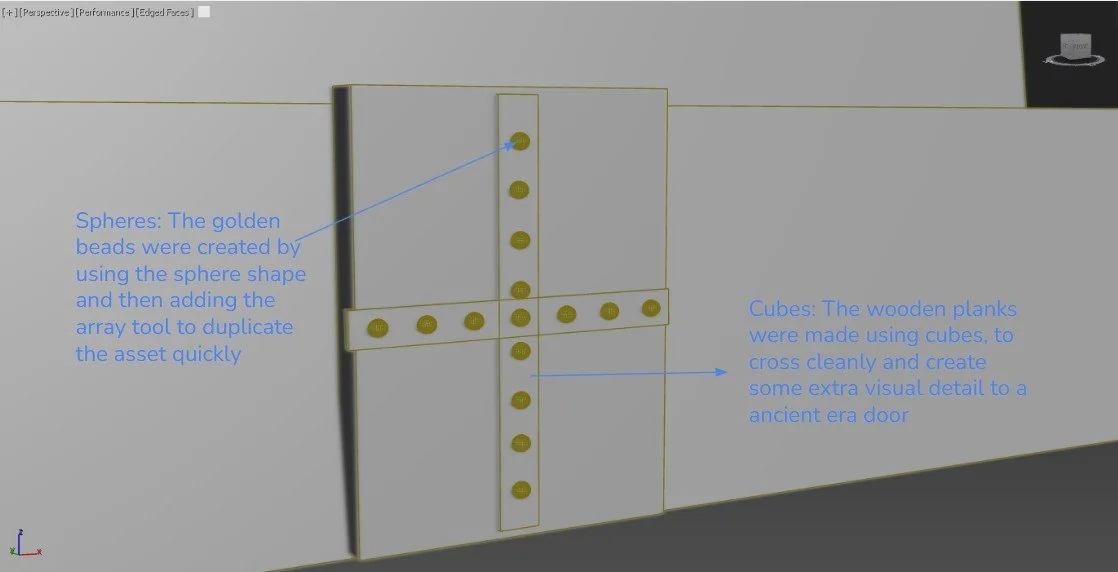
Figure 1.5
Lighthouse Windows
The lighthouse windows taught me a new skill that was incredibly beneficial for saving time and reducing my workload. The array tool allowed me to make clones of the asset while also providing a setting that creates accurate spacing between assets. I applied this tool to duplicate the assets equally across the 4 faces, which was more efficient compared to manually positioning the assets using the clone tool. The feedback that I received on my model was that the windows did not reflect ancient architecture. I decided to replace the basic cubes with the arch design, which made model more historically appealing.
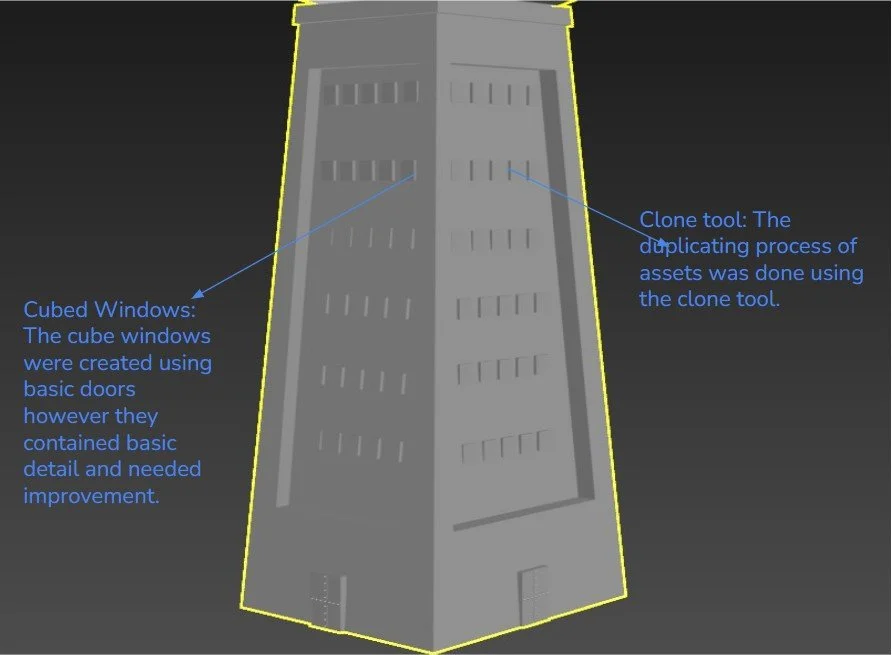
Figure 1.6
Before feedback
After feedback
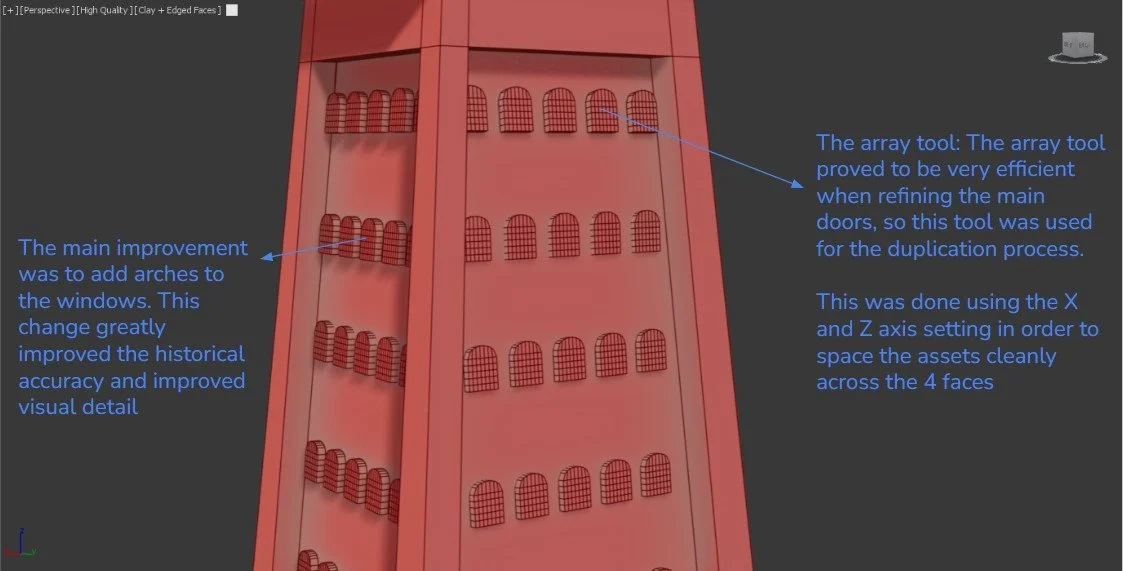
Figure 1.7
Hexagon Tower
The hexagonal tower was the second upper tier in the lighthouse; some iterations I have seen have different shapes, however, the one I found for my sketch had a hexagonal structure. This approach was selected to maintain symmetry while also retaining a lower polygon count. After receiving feedback, I was informed that both the second tower and the support pillars were missing. I was made aware that support beams are necessary for the weight of the structure and to improve historical realism. To create the second tower, I cloned the original tower, with the only change being a reduction in scale and reverting my cube windows into arches. This method shows the effectiveness and reusability of a modular workflow, which was crucial for me to make these specific changes.
Modelling development 02
(Upper-Tier)
Before feedback
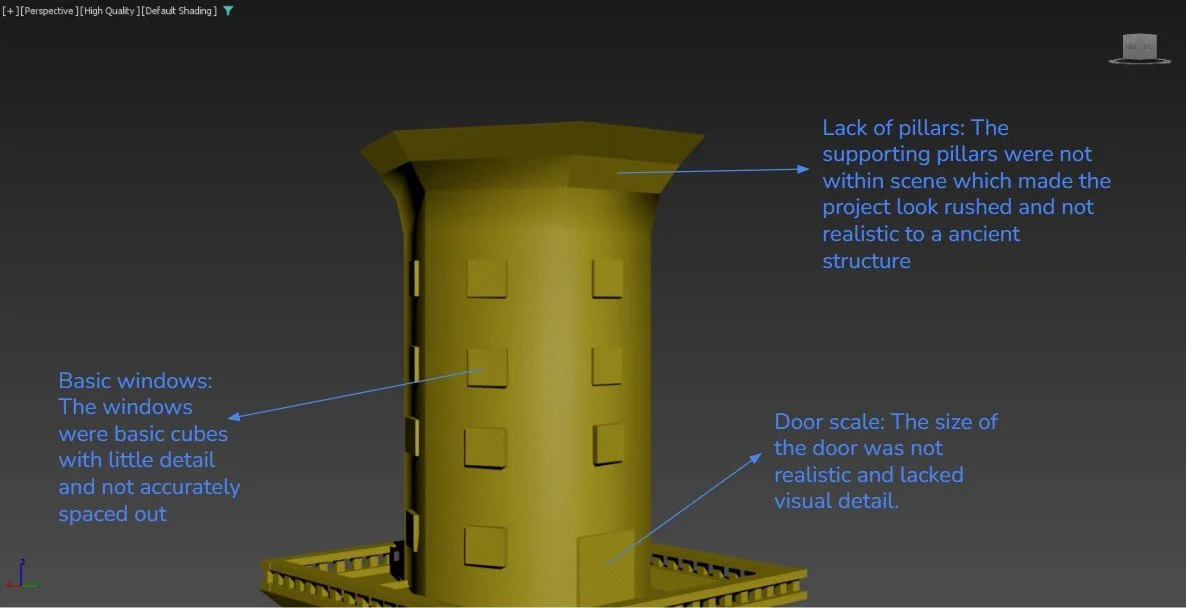
Figure 1.8
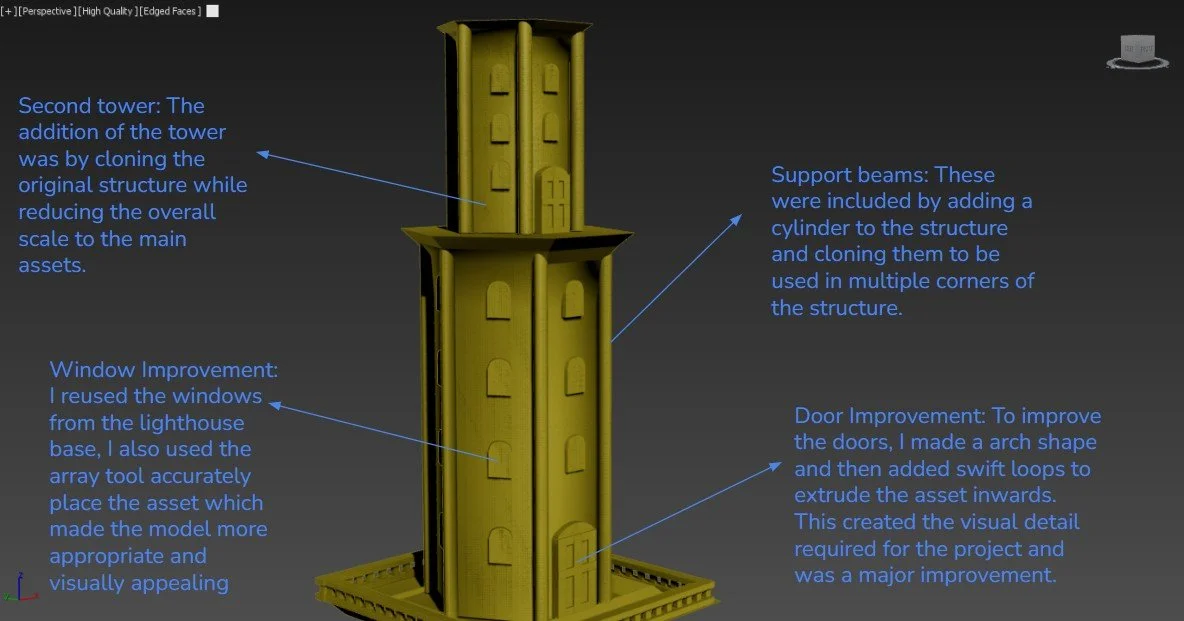
After feedback
Figure 1.9
Upper tower (Brazier Level)
The design for the brazier level had 3 unique assets: The Pillars, the Coned roof and finally the brazier. The Pillars were designed using cubes, and this was to offer some variety to the model rather than using the cylinders. This offered more opportunities to work with other tools and techniques, and therefore added more detail. The coned roof was made using a cylinder, mainly because this shape has iteration settings to create smooth and symmetrical faces, which, if I were to use the pyramid tool, would have had fewer options for generating the same detail. The brazier development was only challenging in keeping it even between the pillars; to undertake this, I used the pillars as a point of reference from a bird’s-eye view. This made it easier to make sure the asset had clean dimensions from the other assets.
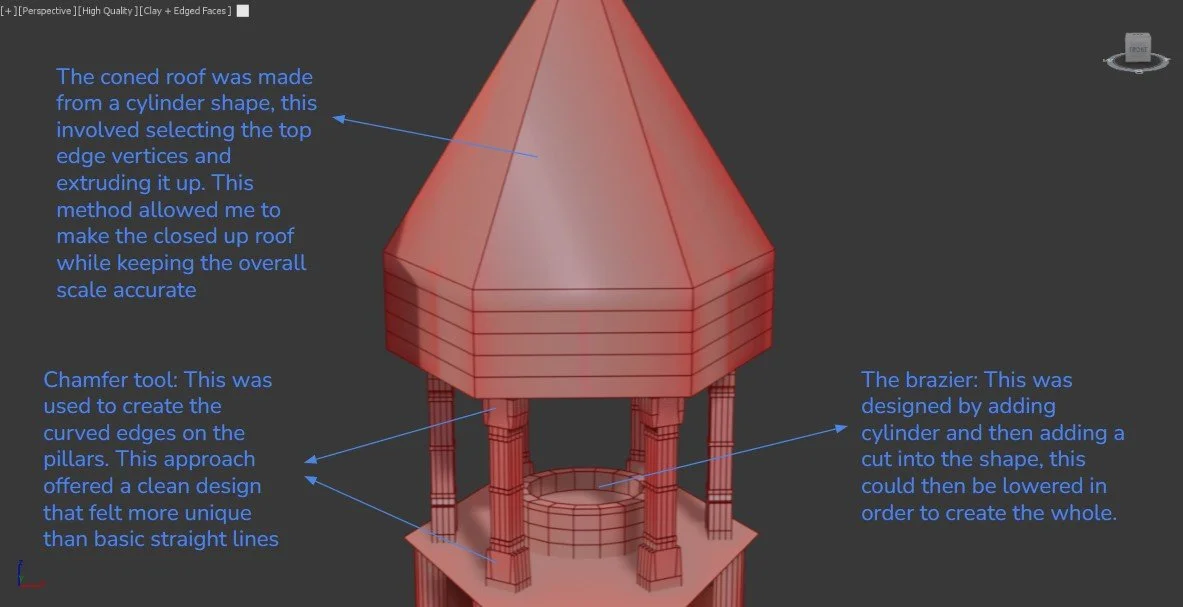
Figure 2
Lighthouse Towers and Walls
The lighthouse towers and walls required significant refinement. The first set of feedback was directed at improving the visual details, like the windows and doors. The approach for this was to use the same windows and doors from the hexagon tower; this will maintain visual consistency between both the lighthouse itself and the towers and walls.
The walls had two new additions: The archway entrance and the stonework. I felt the need to adopt a more realistic approach here, as the assets need to feel visually appealing and appropriate for a historical context. To create the stonework, I added a swift loop to a cube and then extruded that up to create the sharp edges to the shape, then I used the array tool to duplicate them across the 4 wall sections.
Since the cut was already made, I just needed to make the arch to fit the gap made. I opted to model this with the line tool because the bend modifier did not produce the results I aimed for. The line tool proved the best option, as I could create a specific design without worrying about poor typology. Overall, the feedback here focused on architectural details and reinforcing historically appropriate features across the walls and towers.
Modelling development 03
Lighthouse Walls
Before Feedback
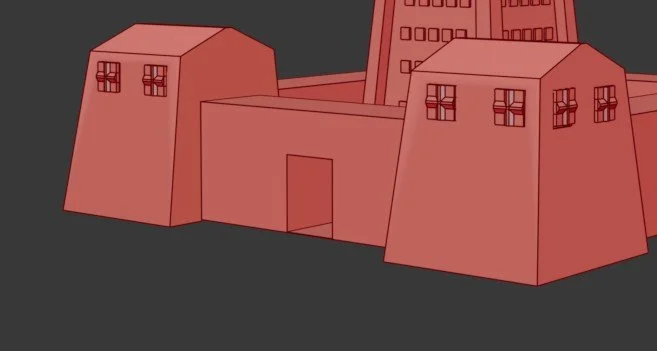
Figure 2.1
After feedback
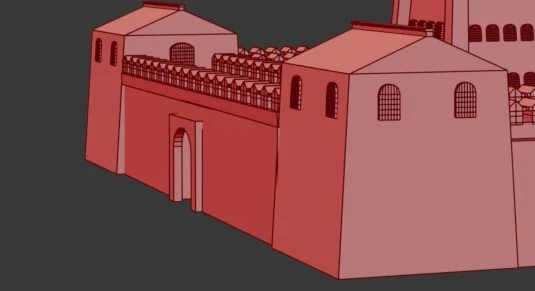
Figure 2.2
Final Textured Renders
Frontal View
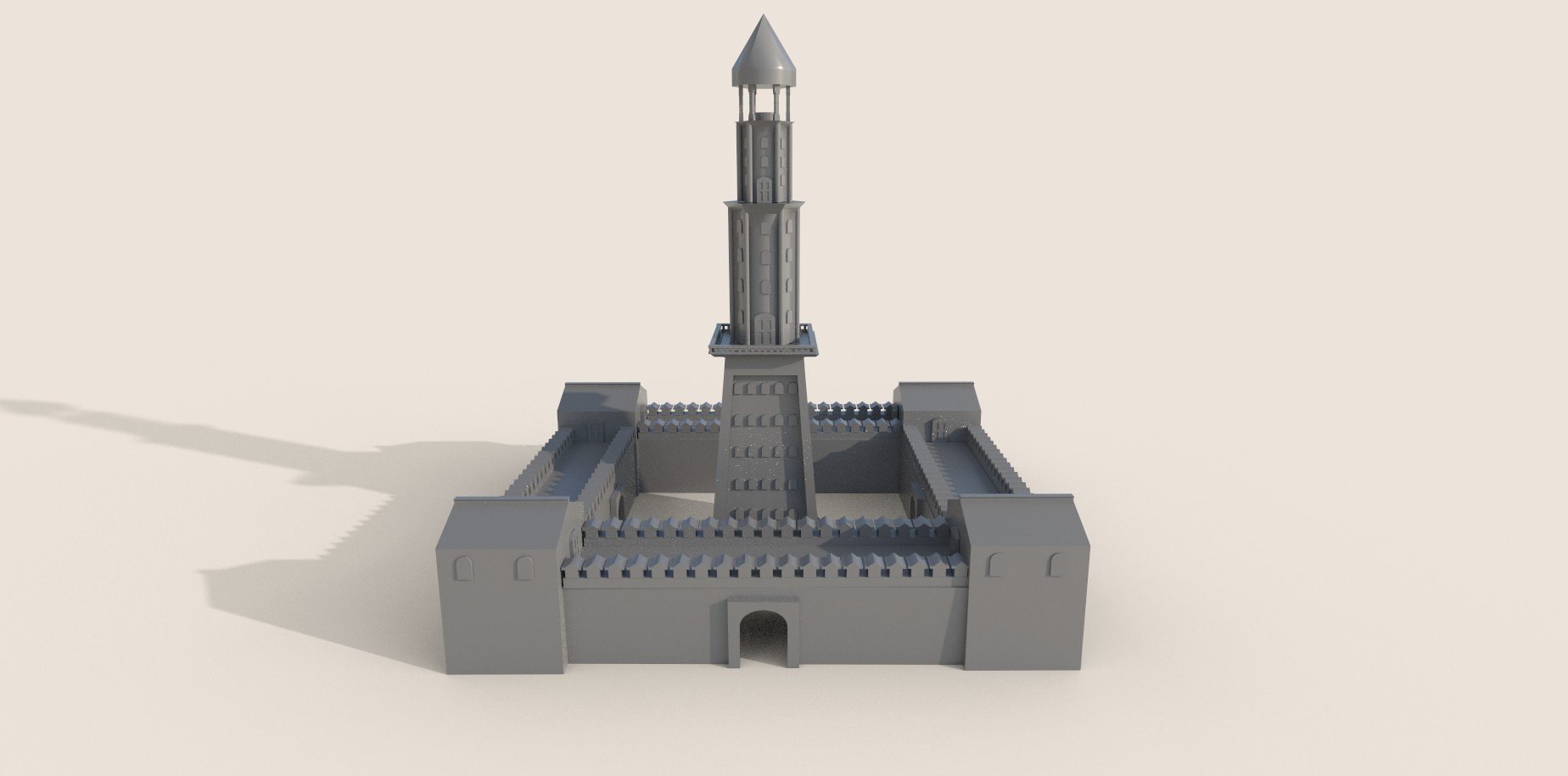
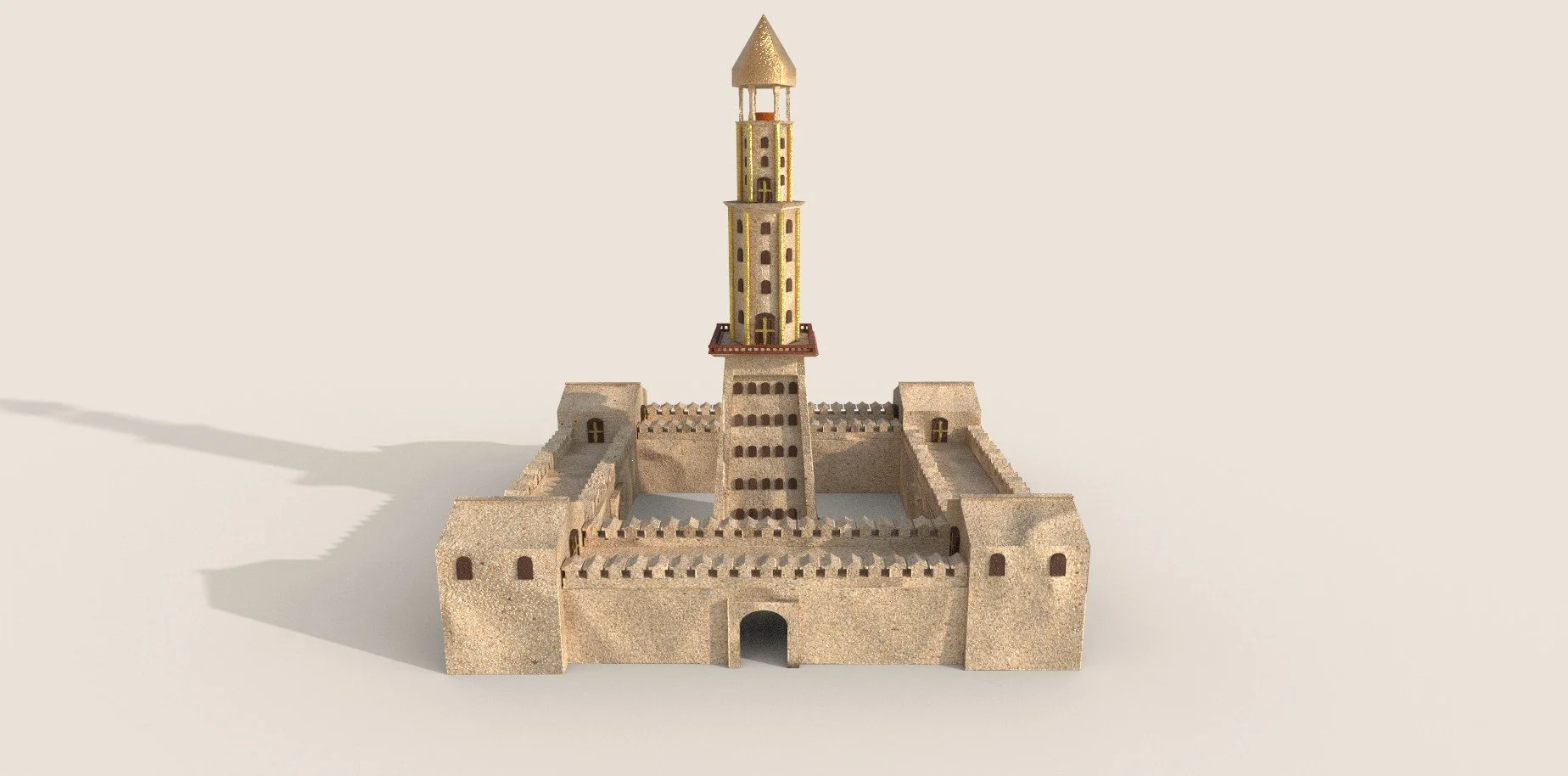
Figure 2.3
Figure 2.4
Angled Overhead View
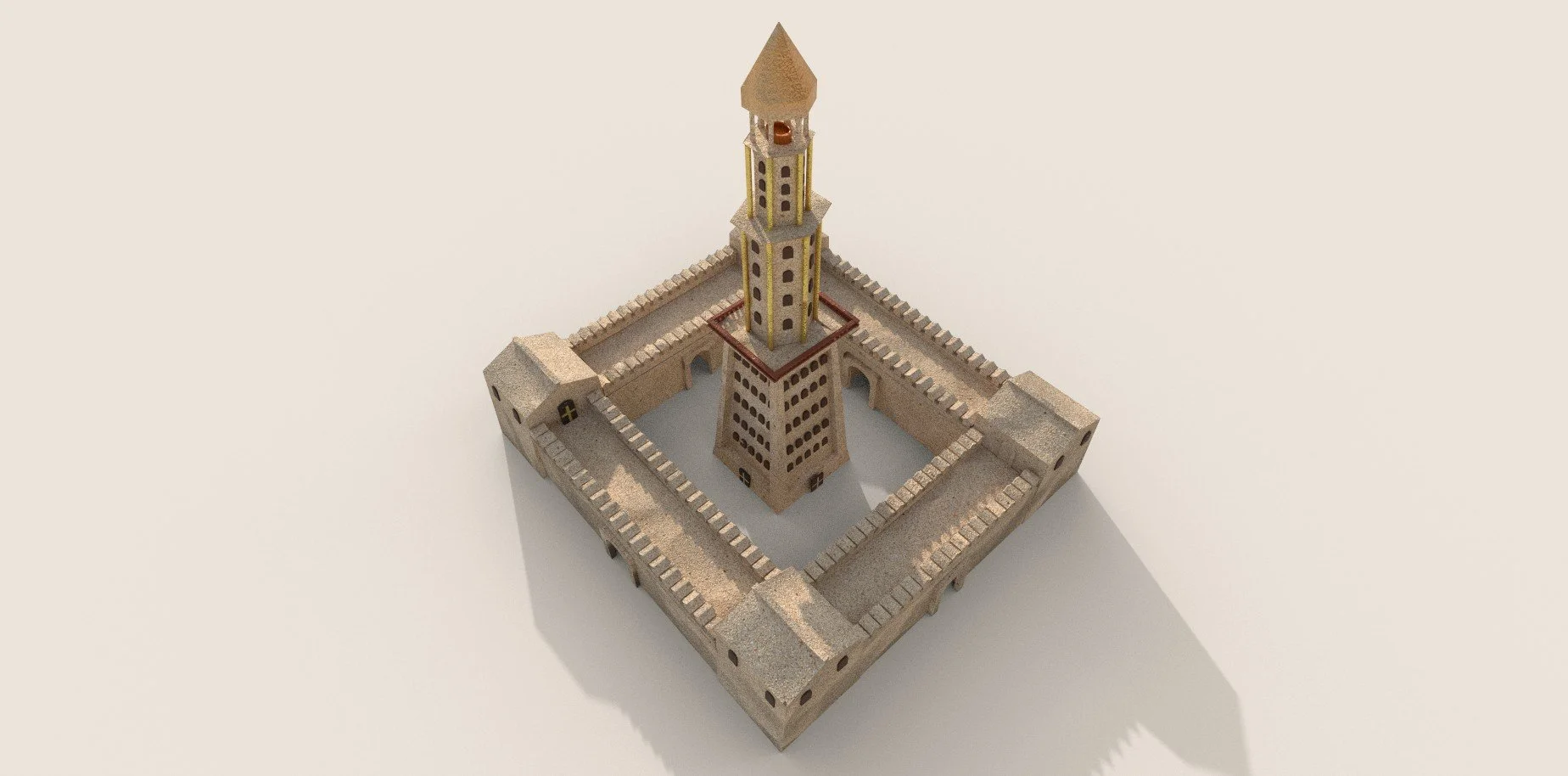
Figure 2.5
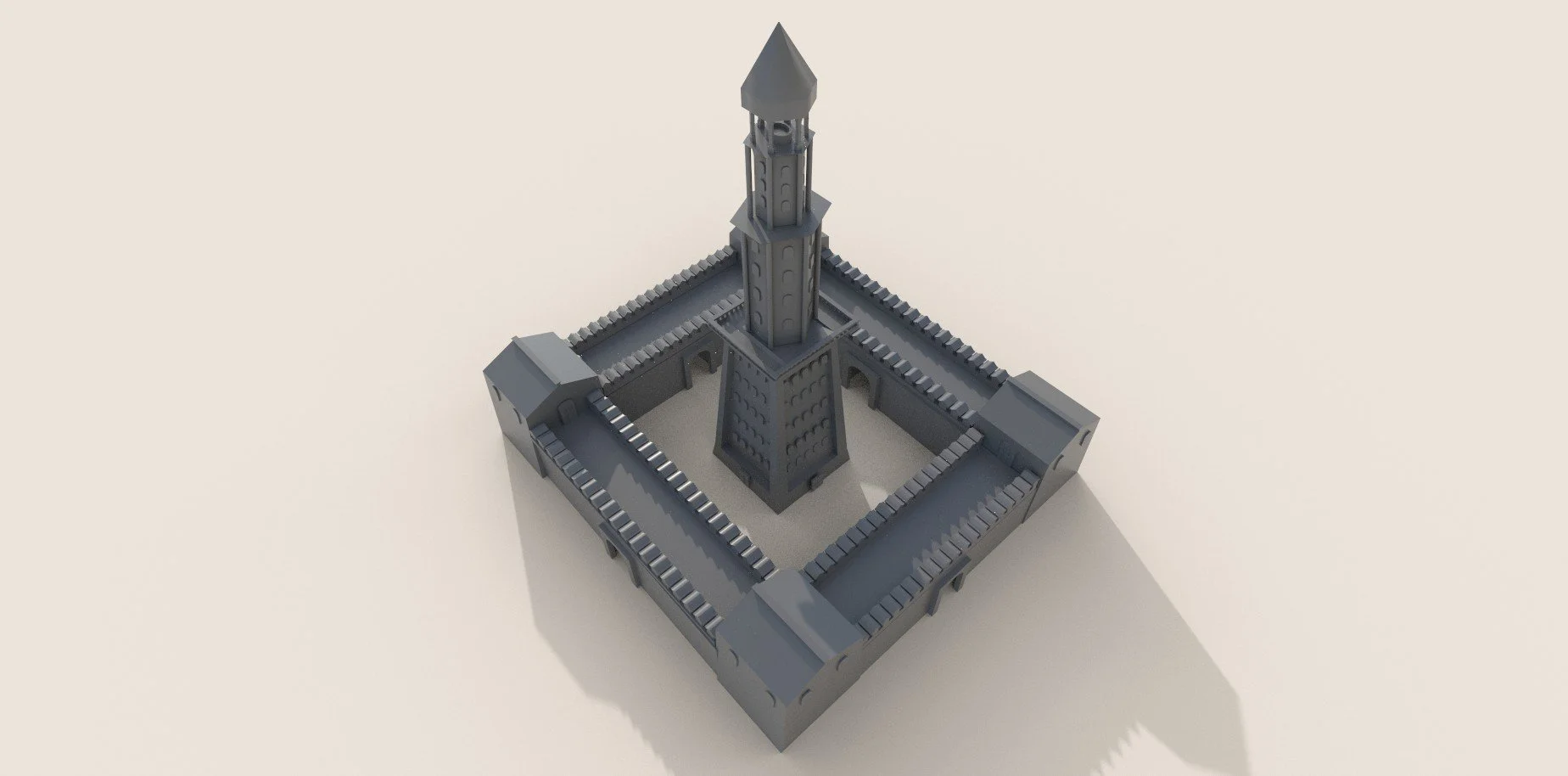
Figure 2.6
Side Elevation
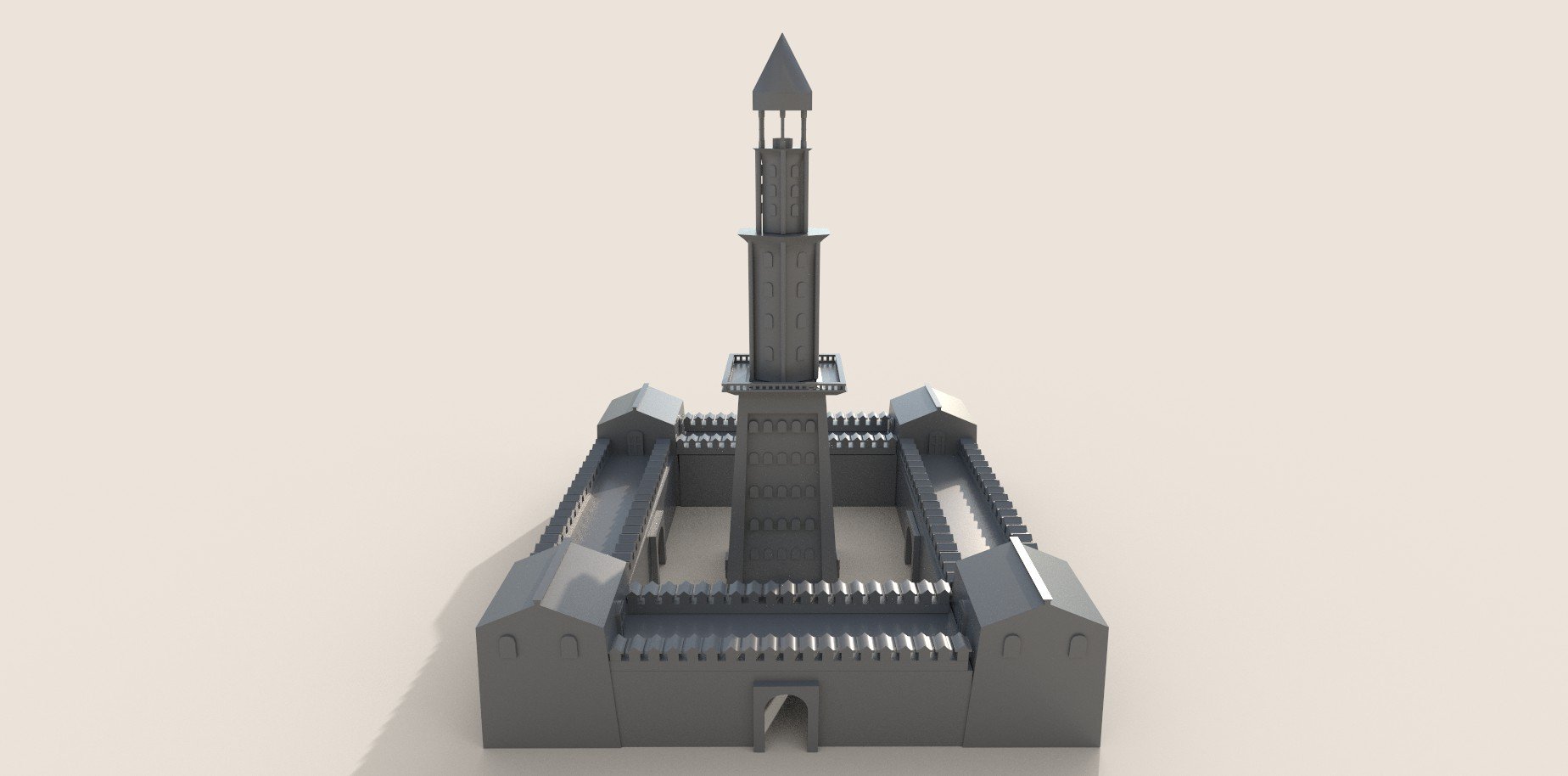
Figure 2.7
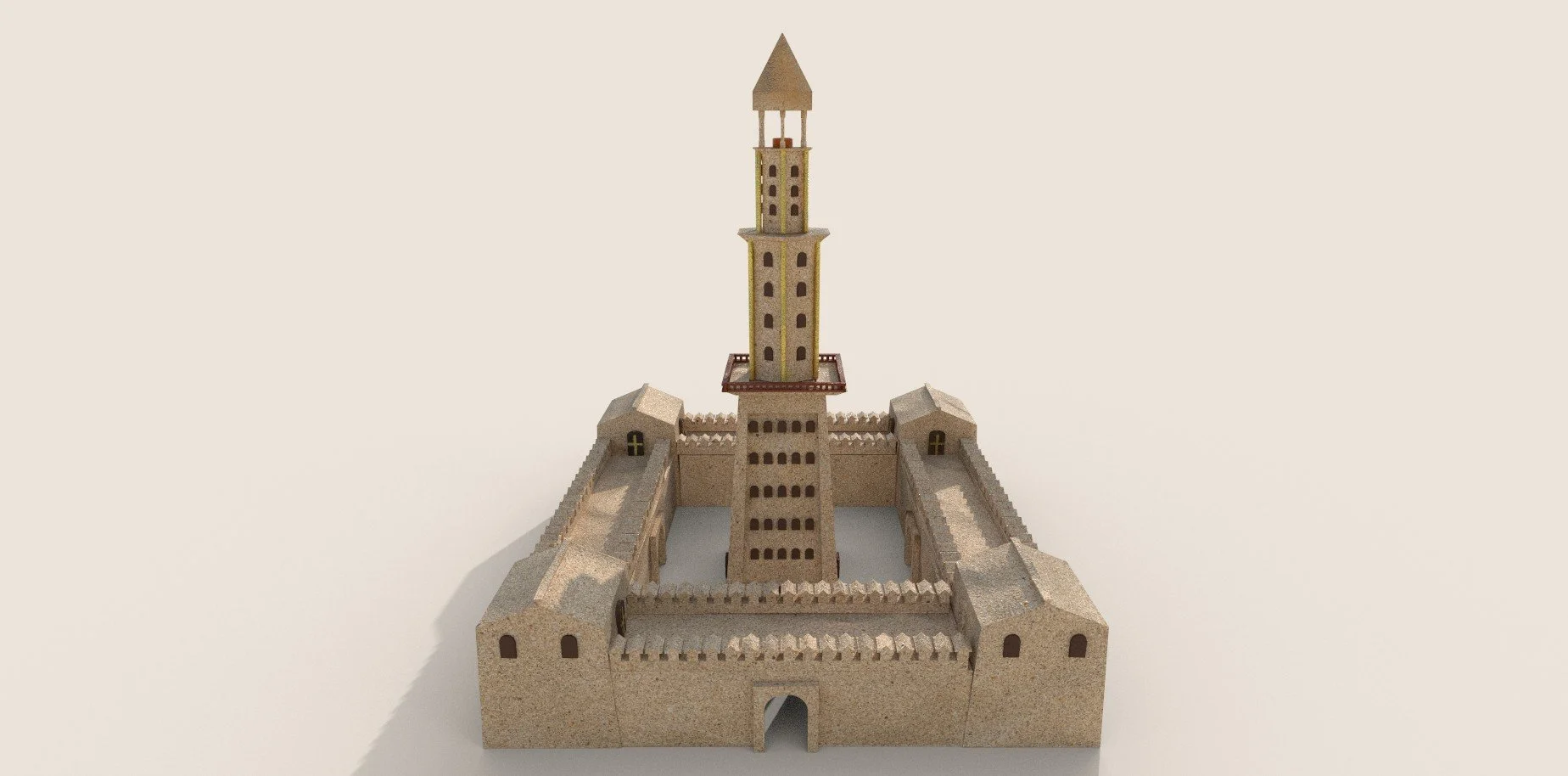
Figure 2.8
Top down View
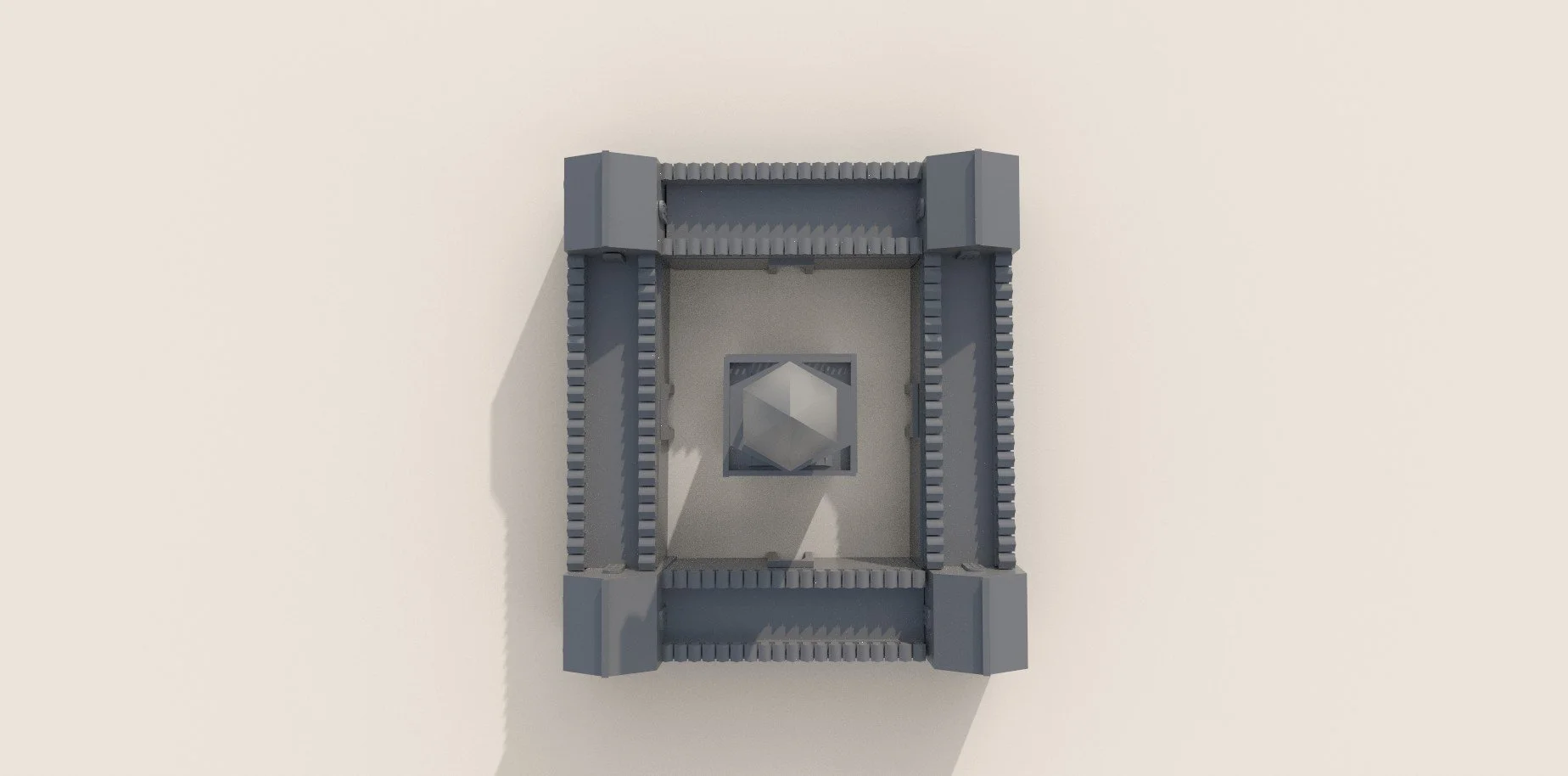
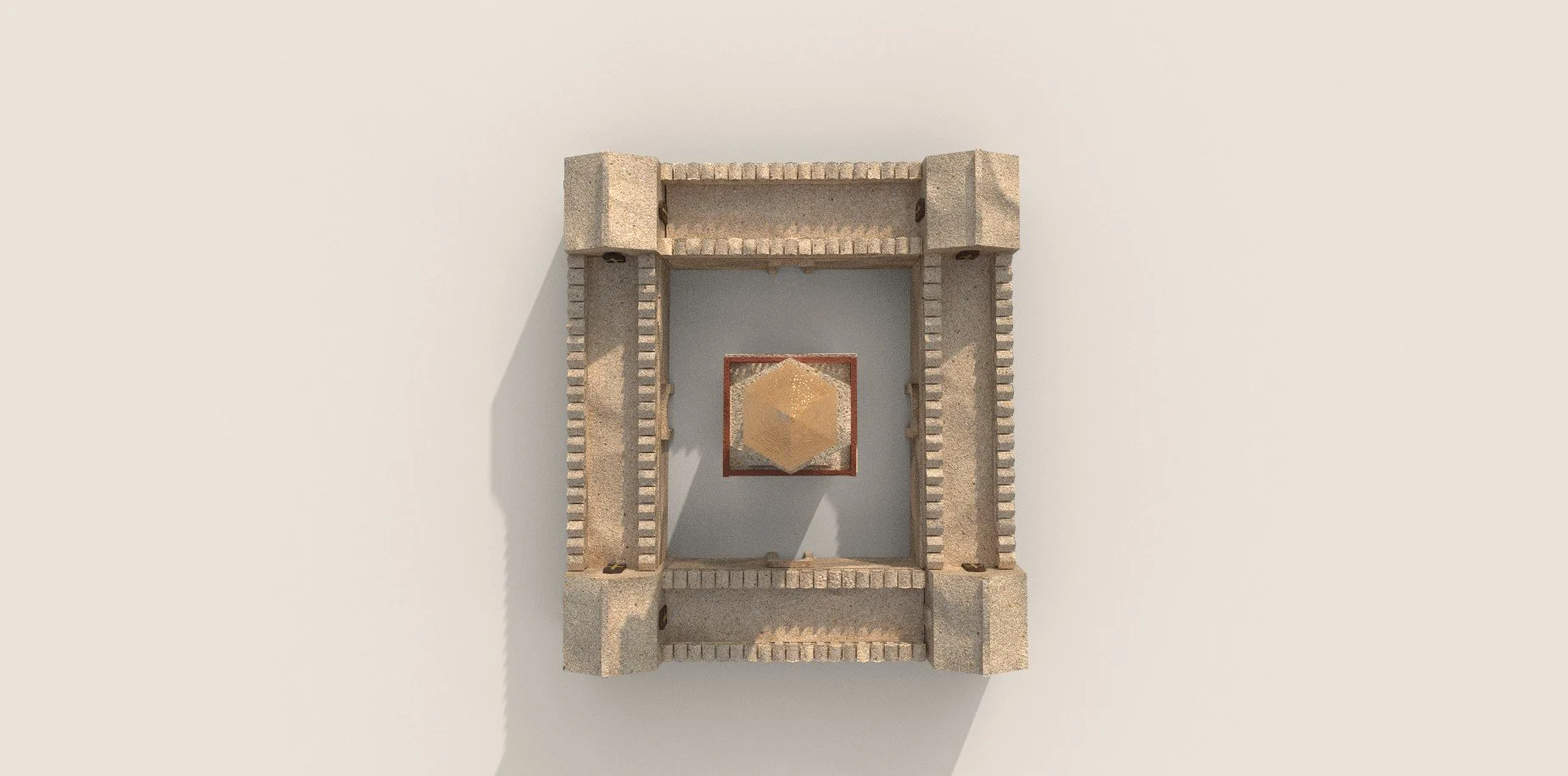
Figure 2.9
Figure 3
Figure 3.1
Iterative feedback and testing 01
Modelling Feedback
The first set of feedback I received through the iterative testing was directed at the lighthouse modelling process. To avoid repetition, the key areas of reflection are below, with my approach discussed in greater detail within the relevant reflection sections.
The feedback and refinement for the lighthouse windows can be located within “lighthouse base”, (see figure 1.6-1.7) the second set of feedback focused on the inconsistency of the octagonal towers, found within “Upper tier” (see figure 1.8-1.9) the final set of feedback focused on the lighthouse walls and towers, which is reflected within “Lighthouse walls and Towers”, (See Figure 2.1-2.2)
Iterative feedback and testing 02
Island of Pharos UE5
The second area of feedback I received through Iterative testing was from a family member, who focused on the presentation of the Island of Pharos, where the lighthouse once stood. The main issue in (Figure 3.2) was that the landscape was too flat and only slightly larger than the asset itself. It was recommended that to achieve this goal, I should create an uneven rocky landscape while also increasing the landscape size. Water was implemented using a plugin which was within Unreal Engine 5 (Epic Games, 2024) . These refinements and improvements can be found within (Figure 3.3)
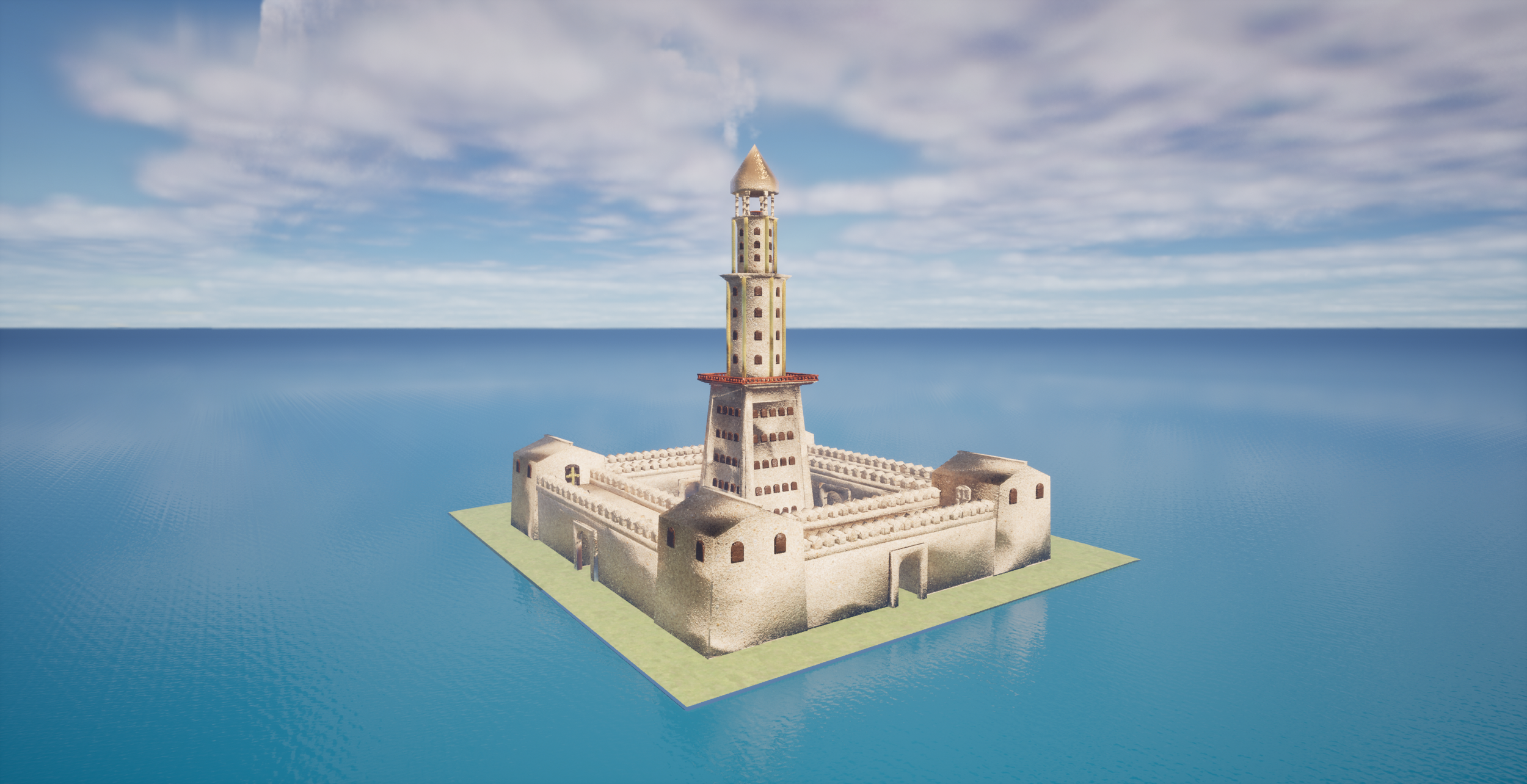
Figure 3.2
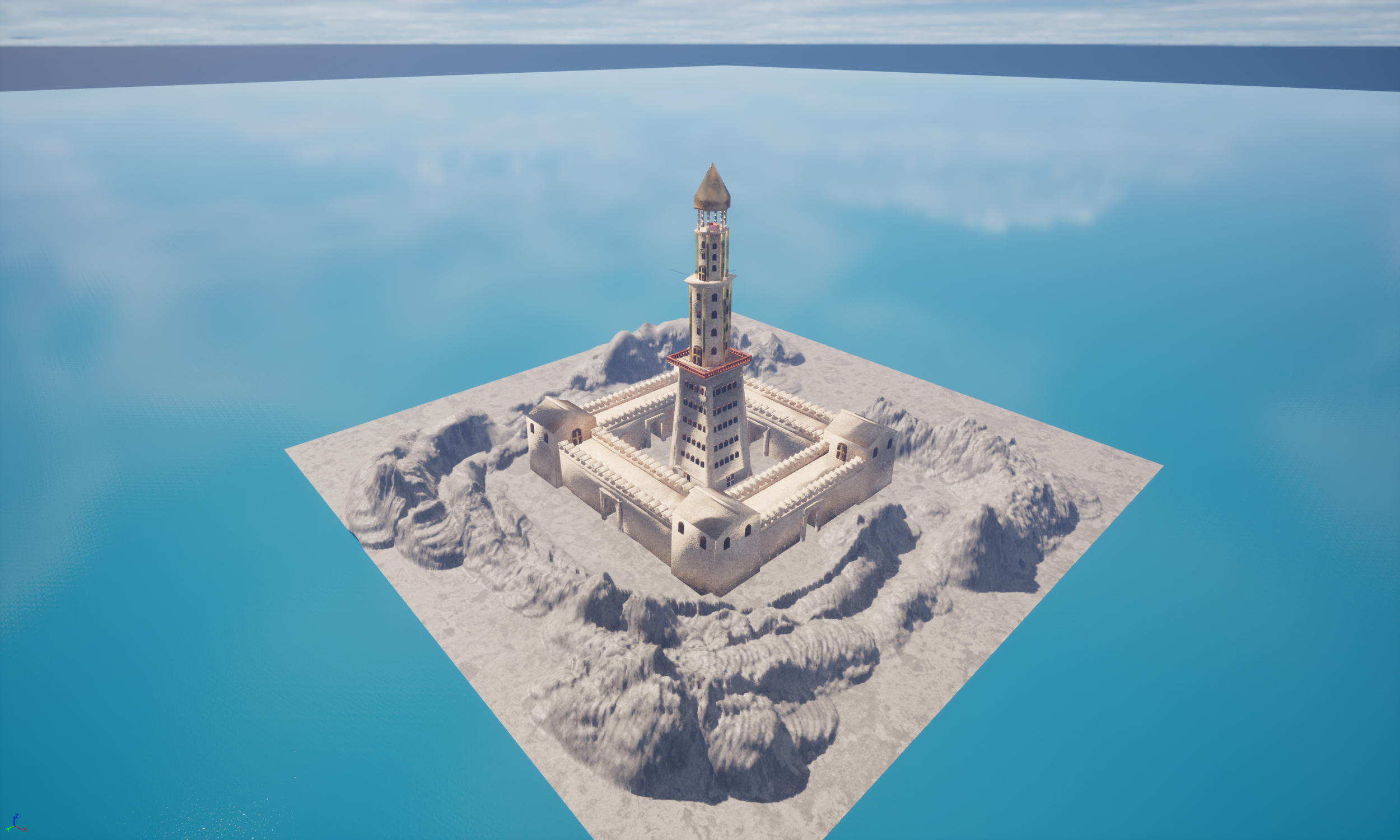
Figure 3.3
UE5 Final Renders
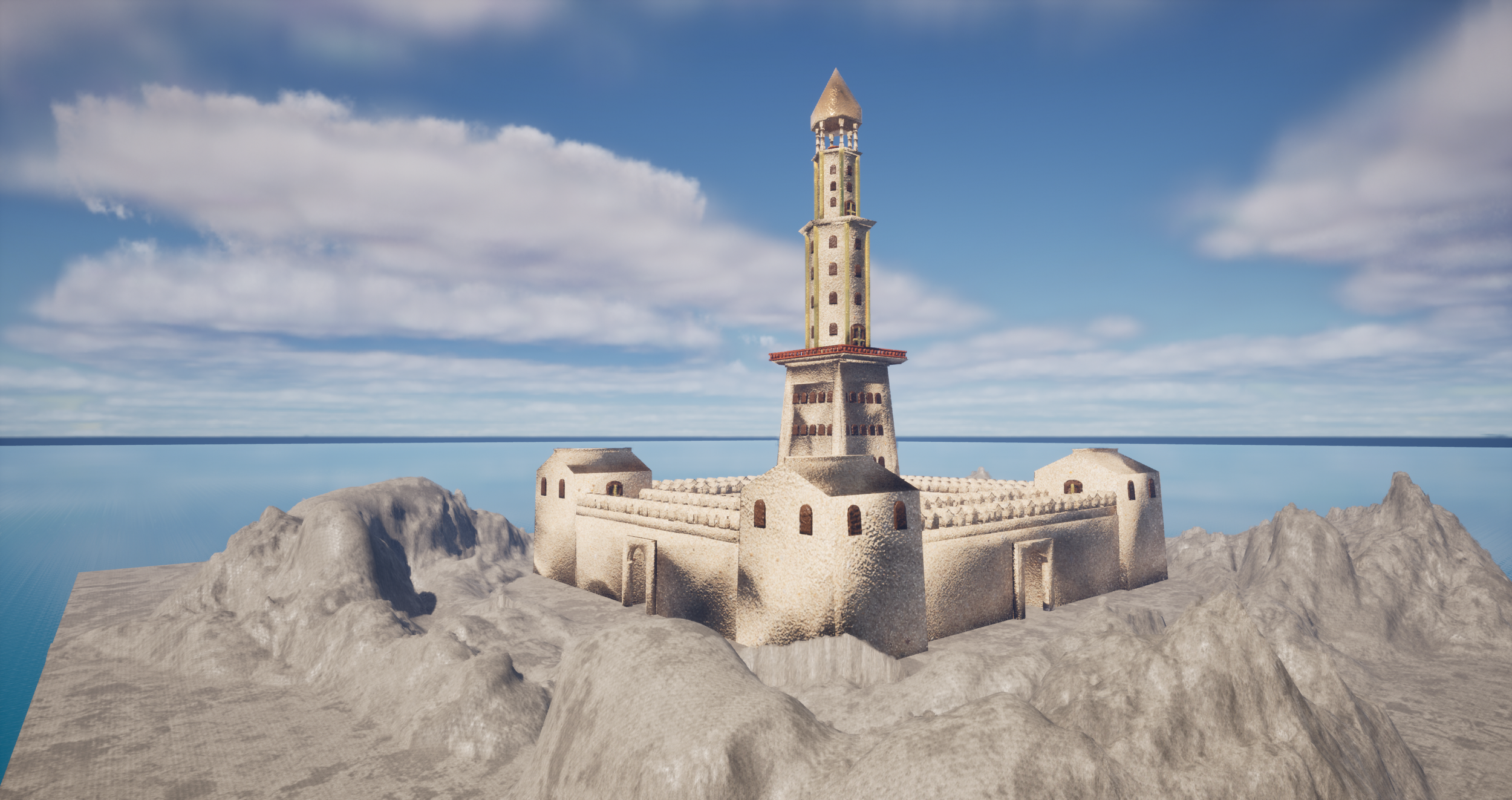
Figure 3.4
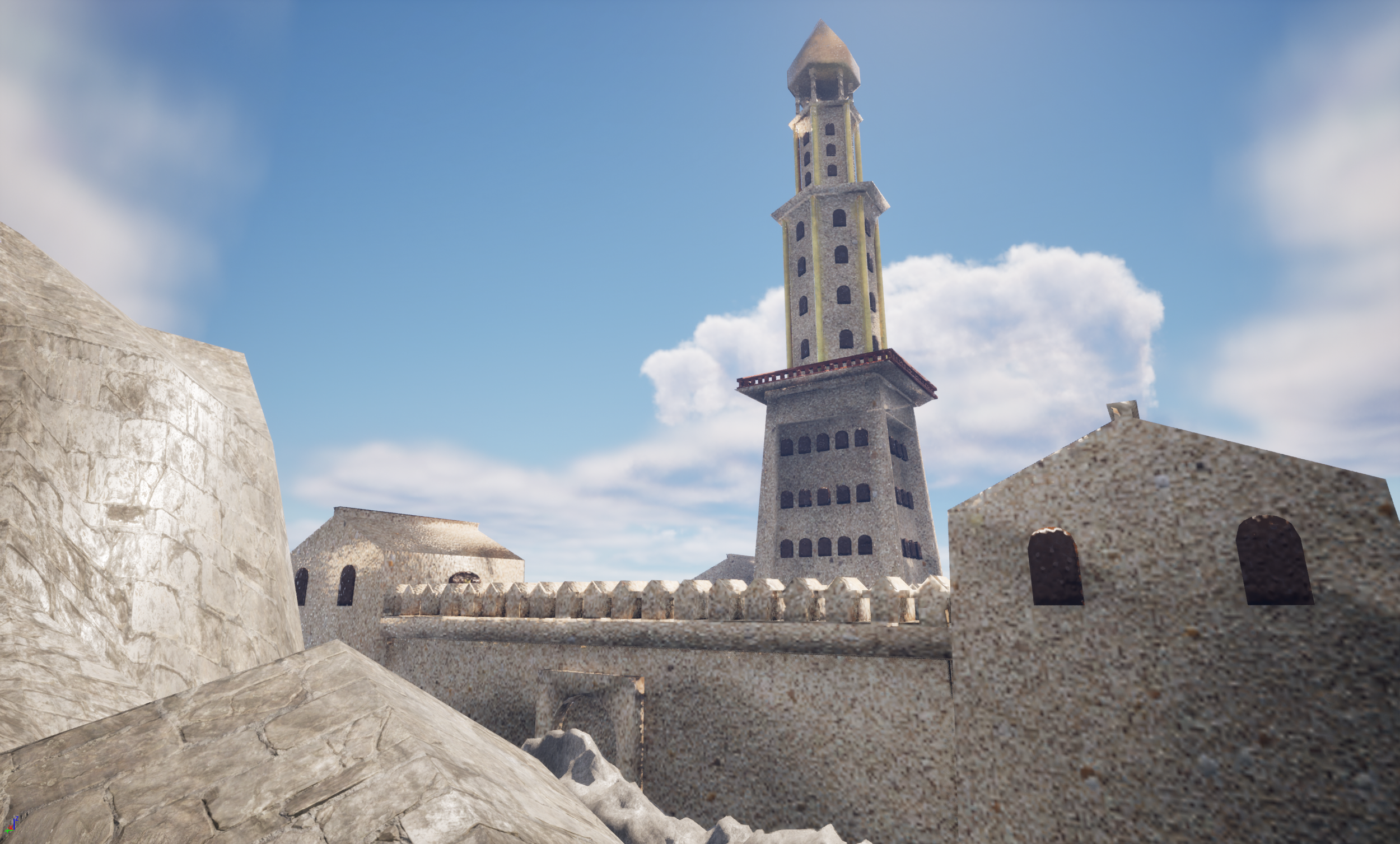
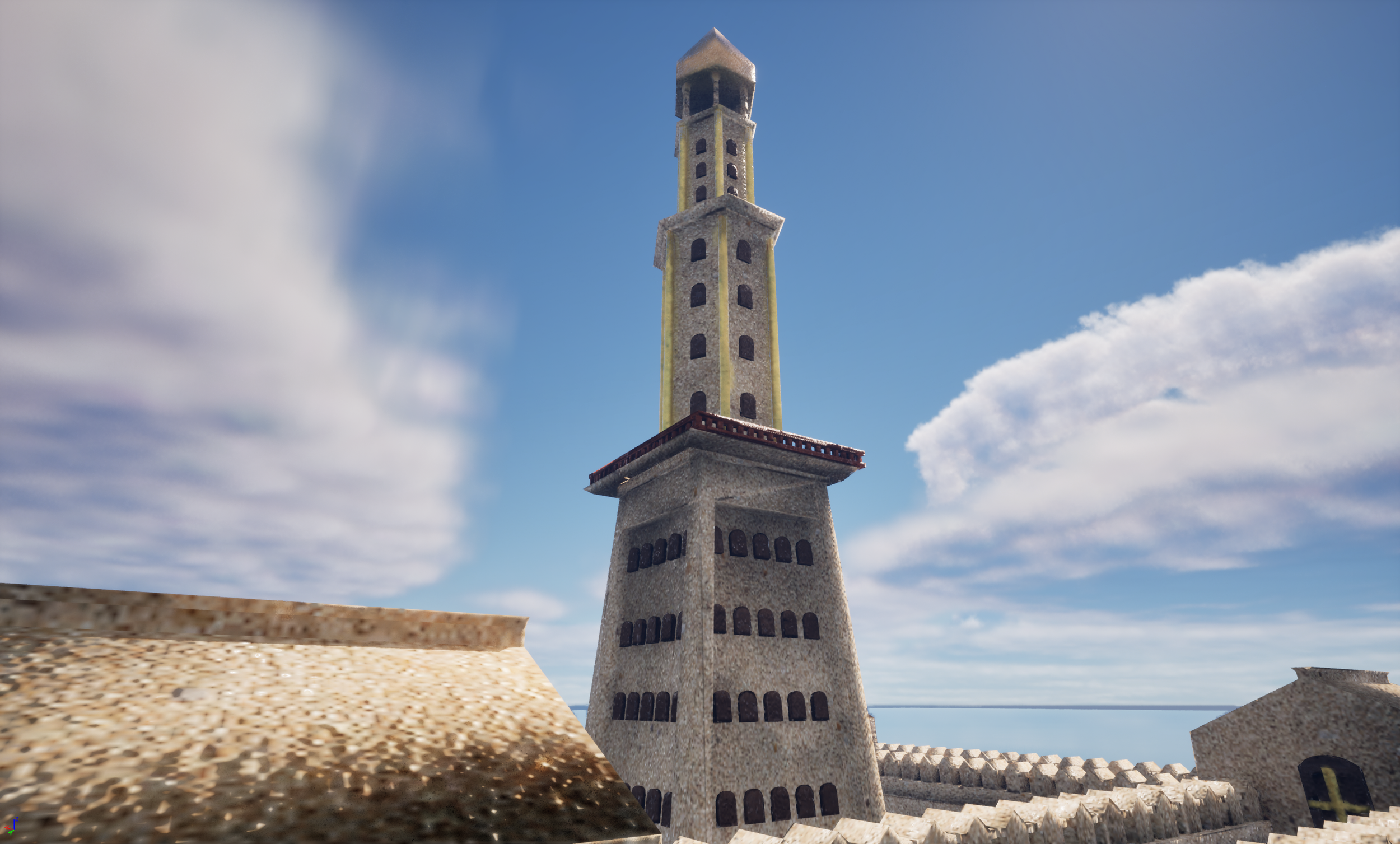
Figure 3.5
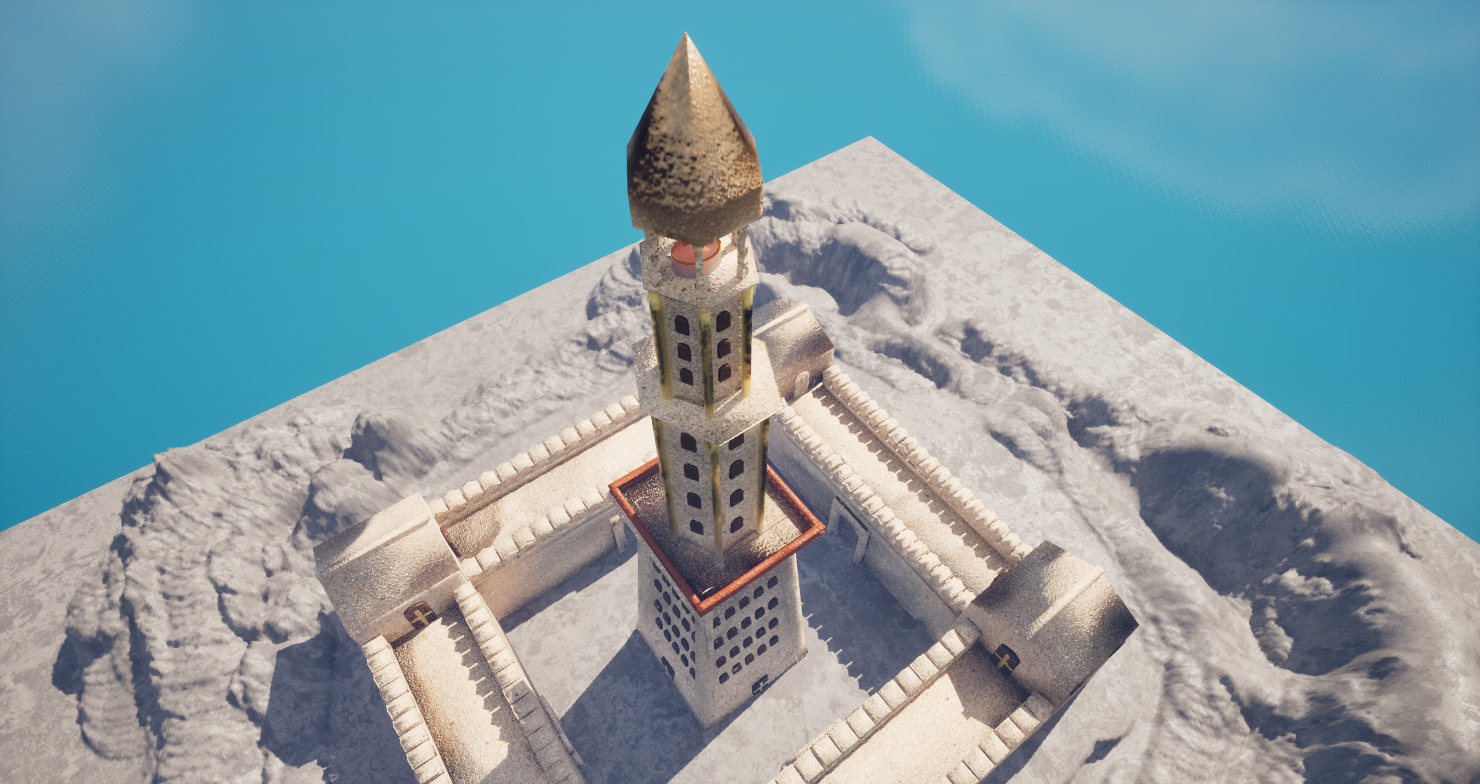
Figure 3.6
Figure 3.7
UE5 Lighthouse Cinematic
Figure 3.8
Time Management
The Trello board (Figure 3.9) outlines the key tasks and challenges that were conducted in each week, which is found under the red tab. The green tab explains the final results and how I overcame specific challenges and tasks throughout the entire project.
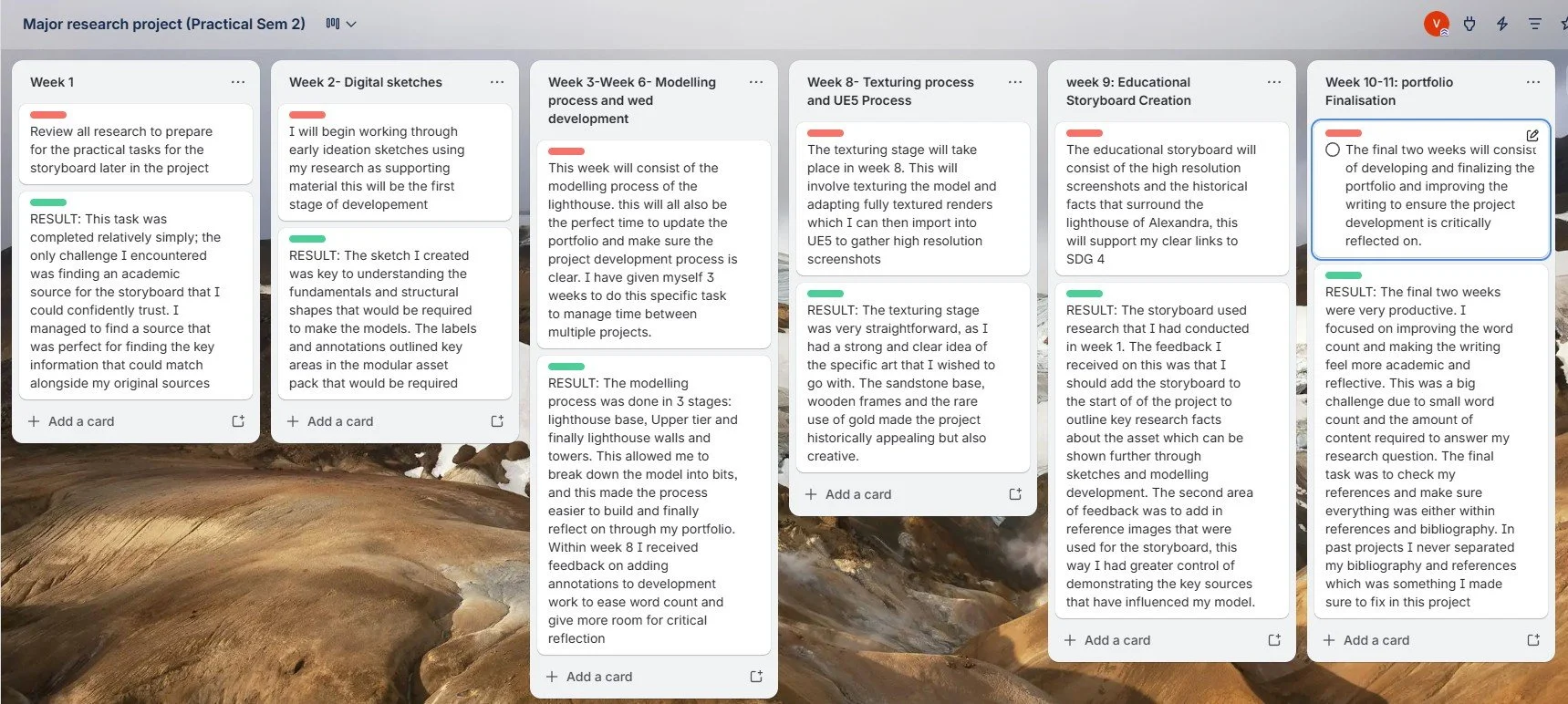
Figure 3.9
How did I utilise my research?
For my primary research, I created 2 polls (Appendix 1) that focused on creativity and historical accuracy, and the other poll was on modular pipelines vs monolithic pipelines. The first poll received strong responses, both from numerical data and feedback, which influenced my decision-making during my practical project. The responses showed me that while historical accuracy is important, some areas may require more creativity as long as the structure remains believable and respectful to the culture. An example of this was when I was building the main doors. Since I could not find any clear references, I decided to improvise and focus on making the asset reflective of the materials available in that era to maintain historical accuracy while also adding my own interpretation. The second poll was overwhelmingly in favour of following a modular workflow, which is what led me to make my own modular pack and follow that specific pipeline over monolithic.
The secondary research was mainly focused on identifying the most effective modelling pipeline for developing complex and historical structures. While I have never created a modular asset pack, my research strongly suggested that a modular asset workflow would be the best way to approach this project. One industry source explains that modular asset workflows break complex structure into simple reusable components that can improve efficiency and scalability within a development pipeline (Skrobiś, 2020). This concept of reusable assets was very common in my project, for example, the key assets like windows, doors and pillars are reused, which greatly saved time and made the modelling process more enjoyable. Compared to the monolithic approach, this method works where the entire unit is built using a single, tightly integrated asset (Skrobiś, 2020). If I were to use this method, I feel I may have encountered difficulties maintaining the consistency and scaling on assets. This is why I decided to focus my attention on using a modular asset workflow.
Conclusion
I will now begin to conclude and evaluate whether 3d game development methods have a place in helping to digitally reconstruct lost structures like the lighthouse of Alexandria.
My primary research played a key role in shaping the project direction. The creativity vs historical role helped guide my decisions during the modelling process through certain assets like doors and pillars. My commitment to historical accuracy had to be altered due to a lack of clear historical references to certain assets, which meant I could be more creative as long as my designs retained a close, authentic look. My poll on this topic received mixed responses on both sides, and based on my experiences, I can absolutely see the positives and the challenges that I faced with this method.
The most difficult challenge I’ve had with 3d modelling was managing time and being more efficient with the assets I work with. The great benefit on a modular asset workflow is that realisability of assets makes the process less time-consuming. One way I did it was by using tools like clone and array. While I had used the clone tool, I had never touched the array tool, and this worked very similarly, allowing space to be made between assets and not requiring human judgment of the position of assets. This, in the long run, removed the repetitive tasks.
This project demonstrates the importance of following a game development workflow, specifically a modular asset workflow. This increases efficiency and encourages reusability, which is important for a 3d model with multiple different parts that require consistency and accuracy. Having adequate reference images was also essential, as having limited imagery can affect historical authenticity, which required careful creativity that closely aligned with the culture.
The use of an educational storyboard and the lighthouse modelling tutorial clearly demonstrates how my project closely align to sdg 4, by promoting accessible learning while creating a fresh and immersive learning experience. Overall, this project demonstrates how 3d game development can be used to bring the lost lighthouse of Alexandria back to life through an educational context.
Handover files and Design documentation
The handover files include my downloadable modular asset pack. Alongside this, my design documentation provides a step-by-step manual for how to model the lighthouse. This tutorial demonstrates how the modular asset pipeline can operate within a modelling practice. I am also able to link this aspect of the project to SDG 4 due to my commitment to interactive learning and education.
References and bibliography
References
Adel, A. (2026) Lighthouse of Alexandria. ArtStation. Available at: https://www.artstation.com/artwork/DLrvO0 (Accessed: 27 April 2026).
Baker, C. (2017) ‘The Lighthouse at Pharos – A Narrative’, Tenor of Our Times, 6(1). Available at: https://scholarworks.harding.edu/tenor/vol6/iss1/7/ (Accessed: 28 February 2026).
Becker, L. (2024) ‘The Lighthouse of Alexandria’, Ancient Engineering Marvels, 26 September. Available at: https://ancientengineeringmarvels.com/the-lighthouse-of-alexandria/ (Accessed: 14 November 2025).
Cartwright, M. (2018) ‘Lighthouse of Alexandria’, World History Encyclopedia. Available at: https://www.worldhistory.org/Lighthouse_of_Alexandria/ (Accessed: 28 February 2026).
Kaya, G. (2019) Lighthouse of Alexandria. ArtStation. Available at: https://www.artstation.com/artwork/rRZD65 (Accessed: 27 April 2026).
Kok, K. (2017) Assassin’s Creed Origins: Lighthouse of Alexandria. ArtStation. Available at: https://www.artstation.com/artwork/dDEaK (Accessed: 4 December 2025).
Skrobiś, I. (2020) ‘How does modular software architecture improve scalability?’, Medium. Available at: https://medium.com/selleo/how-does-modular-software-architecture-improve-scalability-8d515e6f408f (Accessed: 4 December 2025).
Bibliography
Encyclopaedia Britannica (n.d.) ‘Lighthouse of Alexandria’. Encyclopaedia Britannica. Available at: https://www.britannica.com/topic/lighthouse-of-Alexandria (Accessed: 4 December 2025).
Epic Games (2024) Unreal Engine Water System Documentation. Available at: https://docs.unrealengine.com/ (Accessed: 15 April 2026).
Pliny the Elder (n.d.) Natural History, Book 36. Available at: http://www.perseus.tufts.edu/hopper/text?doc=Plin.+Nat.+36 (Accessed: 28 February 2026).
Strabo (n.d.) Geographica, Book 17. Available at: http://www.perseus.tufts.edu/hopper/text?doc=Strabo+17 (Accessed: 28 February 2026).
Wikipedia contributors (2026) ‘Lighthouse of Alexandria’. Wikipedia. Available at: https://en.wikipedia.org/wiki/Lighthouse_of_Alexandria (Accessed: 28 February 2026).